Monday, 18 January 2016

Riding the Iron Ram

On my last post, I closed by saying that I'd see you next time at Karioitahi Beach. Well, I've decided to put that on hold and start this series of posts (probably four or five) about our recent trip to Wellington instead...


The first book by Paul Theroux I read was Riding the Iron Rooster. It is a travelogue of his railroad journeys across China. If you haven't read any of his travel books, you should. He has a gift for taking his readers along for the ride. I have no such gift for description, but I do have one thing his books don't. I have pictures.  

Here are some shots I took on our recent holiday to Wellington.  

We were up early. We took a taxi into Auckland, to the Strand Rail Station, where we boarded our 'Iron Ram.'

Why did I name it the Iron Ram? Well, no other animal represents New Zealand like the sheep does. I understand that they outnumber us humans here by about 30 to 1. And the train acted like a sheep (ram) I think. It would often take off and thunder down the tracks, full of vigour and a bit of menace, but then seem to forget its mission. It would slow and meander around corners and often stop as if it was deciding where to go from here. Then it seemed to notice the tracks again and we'd be off with the wind flying through our hair. At least it would be while on the open sided observation car.

And besides, the train was coloured rather like a sheep. I'm thinking of suggesting that they mount some big horns on the front.

(I hope that Paul doesn't mind my choice. I did plug his book after all.)
Here is the engine and the observation platform. 

Looking toward the end of the train. There were two passenger cars and the cafe car. It looks from this photo, that only old folks were on the train. Not so. Quite a few families were aboard. In fact, we ran into two families we recognized from the train while walking around Wellington. 

Here, Allie is busy getting morning tea ready for us all. We sampled quite a few of the cafe's offerings, but had also brought along lots of goodies

The view toward the back of the train from our seats. 

The observation platform. It was fun up here. Jeanne especially spent quite a bit of time standing in the breeze. Before too long, we all acquired 'rail legs' (like sea legs only with faster reaction time) 
Going through tunnels wasn't quite as pleasant. No view, for one thing, and the diesel's blast of heat and fumes had folks pulling back from the open windows.

Here is a sign I don't recall having seen before. No description necessary I guess.
We were very fortunate. Our seats and dining table were just one row back from the toilet (not called restrooms here) and the observation car. Very convenient.

Lots of beautiful scenery.

Mount Ruapehu in the distance and sadly, partially in the clouds so the top is obscured. 

The Raumiru Spiral
Here, the train makes a horse shoe curve and then sprials up through more curves and two tunnels.  The  height difference between the northern and southern portions of the north island is 456 feet.  The diagram above the window shows the design.
After several hours 'abored' the train, even seasoned verterans of travel can suffer from ennui. (boredom) Here our two brave lads are making the best of it. 

So far in the journey, the skies have been low and threatening. As we moved further south however, we started getting a mix of sun and shadows. 


Outside Paraparaumu I caught sight in the distance of what I thought might be a statue of Mary. It is clear on  this shot taken at 25 power zoom, but by eye I wasn't sure of what I was looking at. I learned that this was built back in 1958, to commemorate the 100th year anniversary of Mary's appearence at Lourdes. It's 14 meters or about 46 feet tall. 
We have made it to the western coast, just north of Wellington. The sky is finally clear and we can see Kapiti Island about 3 miles off the coast. The island is almost 5 miles long. During the height of the whaling era, 2000 people worked on it.
Today, it is a bird sanctuary and only 50 tourists are allowed on it at a time.  

I was surprised that the surf on this western beach is so gentle. That has not been our experience in the past. 
Looking at Raroa Bay. From this point we head inland again and will reach Wellington in under a half an hour. 

We are minutes away from our destination here as we pass this Marina. The train station is located right on the Bay. 

We made it! Here we are on the seventh floor of the Rydges Hotel on Featherston Street. We walked here from the train station, only about 300 yards.  We're rather tired and hungry and will shortly go down to the restaurant to have dinner.
I'll continue with this adventure when we visit Te Papa, the National Museum. Stay tuned...    -djf

Thursday, 14 January 2016

More from Manukau Heads Lighthouse

Here we are back at the lighthouse. 


Amiri obliged his grandpa's request to run part way down and look up. I was striving for that Vertigo look. 

Wherever you are in New Zealand you'll find works of art that have been produced and donated. This did not have an explanation in front of it. 

Nor did this one. This one reminds me of a whale or porpoise though. You can't tell it from my photo of course, but it swivels on the post and responds to the wind by continualy leaping and bobbing. 
 Looking slightly south west here. Hard to see where the sea and sky meet. 

One of the rare moments when these two perpetual motion machines simultaneously stopped. 

One last look at the lighthouse from the flax grove before we go

We are speeding back toward Waiuku which blurs the grass and the fence posts slightly. We're looking toward the east. In the distance you can see the blue of Manukau Harbor. Thanks for coming along on our lighthouse adventure. See you next time at Karioitahi Beach.   -djf


Friday, 8 January 2016

Manukau Heads Lighthouse


Today's adventure takes us to the Awhitu Peninsula and up to the Manukau Heads Lighthouse, which is located on the northern tip of that peninsula. 

We are currently in the town of Waiuku.  We stopped for a bite of lunch. Here are four photos from around that picturesque little berg.  


This guy is apparently acting as 'town crier' today. If you look carefully, you'll see that he has a trumpet of sorts in his right hand. We watched him walk through town and every now and then make an announcement. He would first climb up on a bench or a rock, then blow his horn a few blasts, and finally launch into an advertisement for a pharmacy that was having a sale that day. Very unique. 

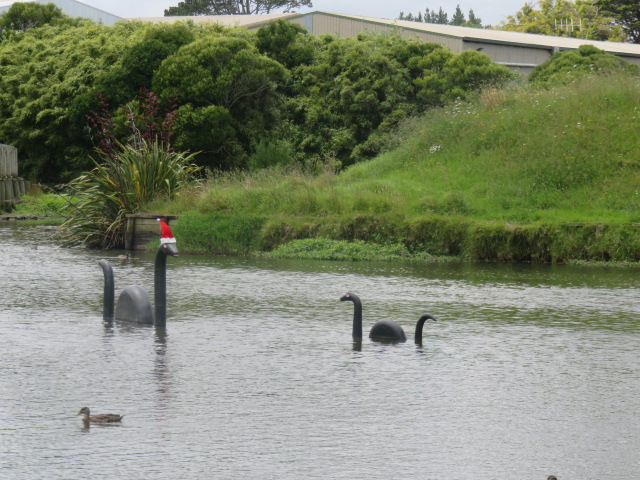
This little body of water is not Loch Ness, it's the Waiuku Stream, but as you can see, it does support a rather exotic pair (at least) of residents. The baby is anchored in such a way that it can revolve 360 degrees and so seems to swim freely near mom.  

Here is our crew awaiting our order at a fish n chips takeaway place. We ate our lunch at the edge of  the Tamakae Reserve and the shore of one finger of the Manukau Harbour. The header photo I used today was taken just feet from where we ate.

When I see statues like this one, I sometimes remember the Indian heads that were all over the Wakefield area when I was a kid. Sadly, most of them are gone now. 
Maybe this guy gave the 'town crier' his inspiration for advertising.


We discovered that the takeaway place was very generous with our order of chips. We had ordered three orders of fish and chips for the five of us. Despite this, we wrapped up quite a few chips to take along for later. We never did eat those chips that day, but we brought them home with us. The next day, Grammy used the chips to make a real Spanish tortilla. We had eaten totillas de potata many times during the times we were in Spain, and the one she made with left-over chips was every bit as good as any of them. 

After lunch, we took the advise from the scary guy in the picture just above, and headed up the Awhitu Peninsula. The lighthouse was just 1/2 hour away now.
The lighthouse is not a very tall one, but it doesn't have to be. It stands on the 240 meter tall (about 787 feet) Maukau Heads. 

There it is. Visiting almost anything interesting in New Zealand means you'll have to do some climbing. This one is no exception. 
Here we are part way up looking back toward the parking lot and the road that leads here.  

There are Allie and the boys on top. The wind up there I'll bet was at least 40 miles an hour. 

In this picture, you are looking toward Whatipu and the Tasman Sea. In 1863, The HMS Orpheus ran aground while trying to enter this harbour and 189 of the 259 men aboard died. The captain was using old charts and the channel had moved. When it hit the sand, the waves and wind pushed the ship sideways and tipped it over on it's side. Only 1 boat was able to get away before it went over. The men climbed up into the rigging to get away from the waves, but eventually the masts broke, dumping the men into the water. Most could not swim. This was New Zealand's worst maritime disaster.

A painting of the wreck is displayed inside the lighthouse.


What a shame that most of the crew died. That Whatipu beach is very wide and sandy. Had they known how to swim, I think most would have been to avoid the sharp volcanic rocks that do exist and land on sand. 

Allie has had both boys in swim classes for the last couple of years. They're doing well.  


I have quite a few more photos so I think I'll continue this on another post.     -djf


Sunday, 3 January 2016

Flat Stanley visits New Zealand

When I came home this morning from shopping for our last minute Christmas grocery needs, I found Flat Stanley waiting patiently outside our front door. (he couldn't reach the knocker)  I brought him in to Allie, who in turn introduced him to Amiri and Arram. The three guys hit it off right away. Not surprising that, Flat Stanley is a likable chap. 

I decided then and there to do a post about Flat Stanley, since he's visiting for a week or three with us. As photogenic as he is, he will really dress up this post.

Flat Stanley arrived in Henderson on the day before Christmas, 2015. Unfortunately, it was raining. Still, the boys made him welcome and he seemed to settle in to our family life easily enough. We soon learned that he had come to us from Las Vegas, Nevada, where it is dry most of the time, so maybe the rain today was a pleasant change for him. We also learned all about Flat Stanley's exciting expedition so far. (he has kept a journal)

Flat Stanley is on a real adventure. He has been sent out to tour the U.S.A and the world until April 1st, 2016. He was sent on his mission by a 2nd Grade boy at a school in Florida. He sent Flat Stanley to a family friend to start him on his way. Then, that family sent him on to a friend of theirs. Each family that Flat Stanley visits will find a friend, somewhere else in the world, to send him on to. Flat Stanley's Florida friend and the rest of his class will learn about all the places he visited when Flat Stanley returns with his completed journal to them. Each family of course, will help him with his journal. 

This post is a special way of helping to teach Flat Stanley's friend back in Florida (and the rest of you as well) a little bit of what it is like to live in a suburb of Auckland, New Zealand. 

So, lets meet Flat Stanley. The jet ride from the west coast of the United States to Auckland, took about twelve hours but Flat Stanley doesn't look a bit tired. Here he is being welcomed by Arram (6) and Amiri (8).
"How do you do, Flat Stanley? Welcome to Aotearoa." (Land of the Long White Cloud)

The very next morning was Christmas Day...Yeeeaahhhhh!  Here is a picture of the boys playing their new air hockey game. Flat Stanley cheered them both on. 
It's an exciting game. Arram is ready to block Amiri's shot.

The next picture is very silly. Amiri and Arram are the proud owners of 5 female guinea pigs. A friend of the boys' mum made costumes for them.  Their mum dressed the 'guinea girls' in their clothes and they had a fashion show. 
As you can see, Flat Stanley enjoyed meeting Squeekers, Popcorn, Blaze, Brownie, and Whiskers. The 'girls' don't usually visit in the living room or 'lounge' as it's called in New Zealand, but this is a special occasion. They were all on their best behaviour.  (NZ spelling)
Blaze did become upset at one point, as you can see, when Brownie nibbled a little on Blaze's feathers.  

The day after Christmas is called 'Boxing Day' in New Zealand and is one of the busiest days of the year for shopping. Every store has after Christmas sales.  

Amiri and Arram found that their Grammy, who has a garden in the back yard, had lots of extra green beans and zucchini. They decided to put up a Boxing Day stand along the sidewalk and become businessmen for a while. Flat Stanley was glad to help. He found out that NZ money is quite different from American money. There are no pennies or nickles at all here. The smallest coin is a 10 cent piece. Then there is a 20 cent coin, a 50 cent coin, a dollar coin and a two dollar coin. There are no paper dollar bills. On Boxing day, one American dollar was worth about $1.40  in New Zealand dollars. 
Zuccchini is called courgette in New Zealand. They sold one bag of beans and one of 'corgette' in about an hour.

To introduce Flat Stanley to New Zealand, the boys thought he might like to see a video of Maori people singing a very popular song. The Maori people were the first people to settle in New Zealand, about 700 years ago. This song is called Poi E. 


After lunch, the boys's mum announced that it was time to go to the beach. We all piled into the car and headed out. Just two blocks from our house, we came to the boys' school, called Summerland Primary. Grandpa held Flat Stanley up so he could see it and then turned him so he could have his picture taken in front of it. 
Flat Stanley thought the school was nice. He noticed that the steering wheel in this car is on the right side of the car, and then he noticed that you drive on the left side of the road here. Yipes! It was pretty weird.
Here are Flat Stanley and Arram hanging out at Kaitarakihi Beach. Arram is holding Amiri's metal detector. They actually did find a few coins in the sand.
This beach is on Manakau Harbour which opens into the Tasman Sea. It is low tide now. If it were high tide, the water would be much closer to the grass. 

Since Flat Stanley enjoyed the first beach so much, we decided to take him to another one. First, let me tell something about Summerland Primary School and beaches. 

The school has 680 students from Year 1 to Year 6. Those years are like America's Kindergarten to 5th grade. After Year 6, the students have to go to the middle school of their choice. 

At Summerland Primary School, each class room belongs to a 'pod.' A pod is a group of classrooms that share a small, covered courtyard. The courtyard is covered because in the summer, the sun here is very hot and in the winter, it rains a lot.  

Each pod is named after one of the beaches in the area and has a pod color. Amiri and Arram both belonged to classes in the O'Neills Beach pod. Their beach t-shirt color was bright orange.  

Because of this, the boys thought it would be great if Stanley could visit O'Neils Beach. The next pictures are of Flat Stanley exploring this very wild beach. The day we went was warm, but low clouds made it look dreary. It was still lots of fun to explore the cave that is on the beach. It has a large hole in front and a little tiny hole in the back. Take a look.
This is O'Neills Beach. As you can see, it is overcast, but the wind is from the north, so that means it was a warm day.

As we walked along, we spotted a small cave.

Amiri climbed inside for a look around, but there wasn't much to see. O'Neills Beach has some 'black-sand' on it.  Amiri already has some black sand on his knees. 


Here, Arram and his mum are walking in front of a rocky hillside. You can see rocks that have fallen out of the hill. 

There is the mouth of the cave in the distance. Everyone is making a dash for it. 

They are almost there now. That's a big hill behind the cave, itsn't it?


The entrance to the cave. 

Here is Amiri climbing out through the 'back door' of the cave. 

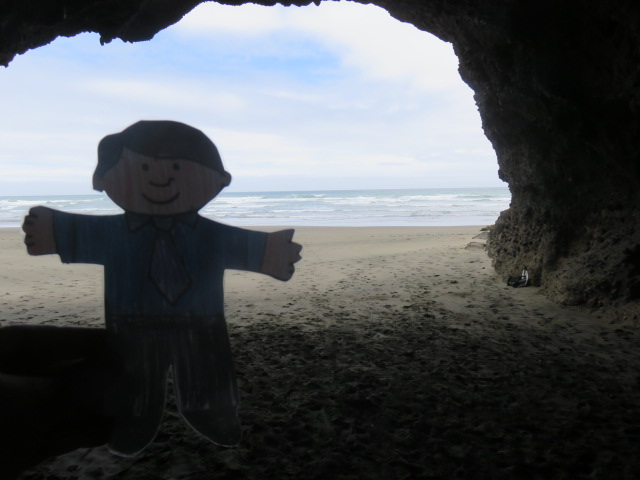
Here is Flat Stanley posing inside the cave. 

Flat Stanley says, "That's the Tasman Sea out there. Australia is on the other side" 

Flat Stanley climbed up into the rocks for a last look around. He sure has had a good time here in New Zealand and especially on O'Neills Beach. 


Flat Stanley will be leaving us soon. He is continuing with his journey of discovery. He is very excited because he has just learned that he will be going to Germany next. 


Bon Voyage Flat Stanley, we'll miss you!                                -djf

Monday, 28 December 2015

A couple of recipes. I like them both.

When I did the post on fish of New Zealand, I showed you whitebait. This recipe is called whitebait, but it is not, it is just supposed to mimic whitebait, using regular fish of any sort. 

White bait is very fine. You don't have to cut up the fillets THAT finely.


The school put this out last year but sales apparently were less than spectacular. They are giving them away now so I stopped the other day and got one...and found this recipe. 

Here's the recipe:

Take whatever fillets of fish you have and slice the fish into really thin strips, almost whitebait size. Season the fish and make sure you use some black pepper to become the 'eyes' of the whitebait.

Put them in a bowl and sprinkle enough flour over them, while turning them over, to coat them all.

Mix up a couple of eggs in a bowl. Take a medium handful of fish and form it into a flat pattie. Dip it into the egg, making sure it is well coated, and then drop it into the pan. Cook them in a mixture of butter and oil (important). Flip when golden.

Jeanne made these for us the other day and we found them very good. It changes the consistency of the fish. It also makes a limited amount of fish go a long way.  

And now for something completely different.  

This next one is called Tero Tero

One day, at the Aussie Butcher, I saw a package of tero tero in the 'offal' section of the cooler. Doing my research later at home, I found that it is pork intestines. Now, I'm not suggesting that any of you search out the same, but the sauce that flavors the porkie bits is the good stuff, and that's what I'm suggesting you try. It's spicy and is great. Here is the list of ingredients from a site on line. I am not going to follow it exactly.
  • 3 tbsp oil
  • 5 cloves crushed garlic
  • 1 kilogram pork tero tero
  • 1/4 cup soy sauce
  • 1/4 cup vinegar
  • 1/2 cup water
  • 3 pcs bay leaf
  • 3 pcs dried chillies(optional)
  • 2 tbsp sugar
  • 1 tsp pepper corns
  • 1 tsp salt
  • 1 tbsp fish sauce
My first suggestion is that you forget about the odd pork parts and substitute pieces of some other meat. Chicken wings would work I suppose or pieces of cut up breast meat or whatever. How about meatballs? Thinly cut pieces of pork steak or chops or whatever would be super because this is a porkish recipe after all.  

Par-boil whatever meat you're using for a bit. 
Get out your frying pan and saute the garlic in the oil.  Add the drained meat chunks. Heat up the meat again and start to brown it a little. Put in the rest of the ingredients. Cook until the sauce gets thick enough to coat the meat nicely.  

A couple of notes. DO NOT use the teaspoon of salt. Taste the sauce and add whatever salt you think it needs AFTER it is done. 

Please try to find and use the fish sauce. It does not make it taste fishy, but I've made this stuff both with and without it and with it is better. It adds a different layer of flavor somehow. 
In fact, when I make this, I add a little more fish sauce than it calls for. (the soy sauce and fish sauce are both salty) 

I also didn't add all that sugar. I'd start with one tbsp. and add more if you think the sauce needs it. This is the sort of recipe that exact amounts do not need to be followed. You should do some tasting before you serve it and add more of this or that if you want to. 

The amount of dried chilies you add too really depends on how hot your chilies are and how hot you like your food. Experiment. 

And I preferred to put in ground black pepper instead of peppercorns. I have never liked biting down on a peppercorn I hadn't noticed. 

Although the recipe I saw on line doesn't mention vegetables, the next time I make this I am going to cut some good sized chunks of carrot and cauliflower. I'll probably add them when I add the meat. I don't want them mushy, I want them a bit crunchy yet, but I think they would add a contrast to just meat. 

This is the kind of thing that you might like to try on a cold afternoon when you don't have anything else to do. It's not a main course, and meant to be served over mashed potatoes. It's an appetiser or something to serve with ice cold beverages of your choice. Do you have a long loaf of French bread? That would go with this too. Your next ball game could be more interesting with this at half-time. 

The island people here love this stuff, as does the Asian community. 

If you do try this, take a walk afterwards in the snow, or do some shoveling and you won't feel so guilty for how many meatballs (or whatever) you spear and savor.  


Monday, 21 December 2015

Te Atatu Peninsula and mangrove mudflats

Today's post takes you to the Te Atatu Peninsula. That is about 10 minutes away from Henderson. It lies to the north of us and makes up the south western side of Waitemata Harbour. (Auckland's harbour)

A note here before we go on. My computer is a Kiwi. Allie bought it for me here and if I don't use the Kiwi spelling of some words, like harbour with that extra u, it pastes yellow boxes on the offending words and generally makes a fuss. You've no doubt already noticed that lots of words look odd to you, that's why. 

I have the feeling that folks who live on the peninsula think that they are pretty lucky. It feels a little hoity-toity out there. I'll bet that home prices are higher there than they are for comparable homes where we live, the Western Heights. I don't quite know why that is.  

It sure isn't because of their fantastic beaches. I've talked a lot about Piha, and Muriwai, Bethells and O'Neils, and Whatipu. Those beaches will take your breath away.  Te Atatu's beaches might sometimes arrest your breathing as well, but that's because the mangrove mud flats that make up Te Atatu's beachs are a, let's see, how to put this, a unique ecosystem, and a producer of, ah, unique smells. 
But it's an interesting place. I was excited to realize when I first saw them, that the low, bush sized trees that grow there were actually mangroves, just like the tropics have, but since they are growing at the very southern edge of the latitude at which it is possible for them to grow, they are stunted. 

The mudflats are home to all sorts of shellfish, and crabs, and who knows what else, all going about the business of living and dying and decaying. 

We just stopped by there the other day, wondering if there was any sea weed for our compost pile. Turned out there was not. 

Nevermind, the boys enjoyed playing on the playground there and I wandered around and snapped a couple of pictures.  Take a look. It is at extreme low tide.


In the background of course is Auckland and the Auckland Harbour Bridge.  Those things sticking up out of the mud in the foreground  are pneumatophores, or aerial roots. A mangrove is an amazing plant once you get to know it. The only trouble is that hanging out with it as you do become better acquainted, is not so pleasant. 

A close up.

The boys had a great time. They had the place to themselves. 

Just a cool looking bit of driftwood

How's that for a stump?

Along the edge of the boardwalk

The boys adopt tough-guy poses.  -djf