Saturday, 27 July 2024

Banned in Denmark!

I know very little about Denmark. If I were to be asked to describe the people of the country, I think I might choose words like cosmopolitan, educated and permissive for my answer. So an article that Jeanne came across a couple weeks ago surprised us.  It seems that Denmark has recently banned a certain noodle. The reason given for pulling Buldak Hot Chicken Flavor Ramen out of stores was that it was a health risk. That surprised us.  

The 'permissive' part of my answer above lead me to believe that the government would not get involved with something so personal as someone's choice of food. So wow!  Those must be some spicey noodles. But to ban them?  Just how spicey could they possibly be?  

Hmm. Well, you know me. Or some of you do anyway.  I headed off to our favorite Korean market and checked the shelves. Yup, there it was.  I opted for a single pack of ramen, just to play it safe. I could always come back and get the economy pack if it turned out that we liked them a lot. I fully expected to. I like hot foods. 

We tried them today for lunch.  


Notice that the up at the top the packaging says it 2 X spicey. 

After cooking the noodles, Jeanne added the first packet of gel-like spice.  


Then, after stirring, she added the second packet of dry spice.  


I think that the labeling means that there are two kinds of spice added to the noodles.  

In my opinion however, after tasting them, I think that 2 X spicey actually means 

    Too (eXpletive) spicey

These noodles were something else.  Definitely the hottest thing I've ever purchased off any shelf.  I sipped some of the soup with a spoon, which tasted good, and then ate three mouthfuls of noodles before it hit me.  About this time, Jeanne, who was across the room with her own bowlful, was shaking her head regretfully and saying, "Nope, not for me, I'm not eating any more of this."

Always a scientist at heart, I didn't want to end my own experimentation without further testing. I rinsed my portion of noodles in two changes of water and tried again.  By this time, my mouth was back to close to normal and the noodles were cooler besides.  It took four additional forkfuls to convince me that further research was ill advised.  The noodles had clearly absorbed enough of spice packets one and two and I was not up to withstanding their effects. 

A week or so after Jeanne shared the 'ban the noodles' article with me, we saw a follow up piece that said that the ban had been lifted.  That upon further review, the legislators had decided the noodles were not actually dangerous. Just hot, really hot, really, really hot. If any of their citizens wanted to subject themselves to such an experience, they were once again welcome to do so.  

We said, "Good for the Danes."  We applaud their bravery. 

Personally, I think that after seeing sales of Buldak noodles soar as the ban is lifted and the residents flock to the stores to try them like I did, sales will plummet, as they try them like I did.  

Or, maybe the Danes are a lot tougher than I am. Who am I to say?  Maybe Denmark has a large Korean population which will continue to make 2 X spicey ramens profitable to keep on the shelves of markets. After all the effort Jeanne and I put into this issue, I'm hoping to see a final article that will address the matter.   

In the meantime, I have decided not to go back and purchase the twelve-pack of  2 X noodles. 

-djf  

Paul Harvey was a radio personality when I was much younger. He had a show that he called, The Rest of the Story. In it, he gave the news behind the news that you'd hear on mainstream TV or radio.  

The rest of the story on these noodles is that Jeanne had also added a package of Udon noodles to the ramen so we had about twice as many noodles as the packages of spices were measured for. We were eating in effect, a diluted product. Yipes.  

And now, the real rest of the story.  I just looked up the Scoville units for this product, expecting it to be half a million at least.  I found it was 10,000.  I must be getting soft. What a wimp.     

Saturday, 20 July 2024

A wise man, Fred, once said, "A guy's got to have projects."

And I of course agreed.  I knew all about projects. Jeanne provided me with what, over the years, seemed like an almost endless list of projects. I sometimes wondered when I'd find the time for my projects. Most of hers added value to our house and three acres. Mine improved our 130 acres of land. I built trails and five deer blinds; what could be better?     

Now that we live in a retirement community in New Zealand, the nature of my projects has changed considerably, but I'm still staying occupied.    

This blog of mine is a major project. I don't feel like going back right now and checking, but I think this post you're reading is roughly my 645th.  I started it back in 2014.  Since then, I've spent countless hours working on it and derived immeasurable pleasure in the process. I'd suggest that a blog ranks very high on the scale of satisfying activities. Some of you might want to consider starting one of your own.


Here is a tasty recent project of historical import.   


Jeanne and I visited Spain three times over the years.  On one occasion, I remember an especially good meal that we enjoyed one evening in an outdoor restaurant in Plaza de Mayor in Madrid. The restaurant we ate at claimed to have been in business for over 150 years, and one of their specialties was Callos Madrilenos. (Tripe cooked the Madrid way.) I loved it.

The waiter obviously identified us as Americans, but we gained in respect when Jeanne, using her Spanish, very expertly ordered a well-known Spanish wine to accompany the meal. When we had finished, he brought us a bottle of plum brandy and tiny fancy glasses, and left it on the table, allowing us to help ourselves. I'm sure he was angling for a big tip, especially since he called me 'patron' each time he checked on us. I'm sure we were generous with him

Anyway, I came across some very good looking tripe the other day at Mr. Meat and decided to try my hand at producing a pot of the real stuff.  I had been missing it all these years, after all. It did turn out very tasty. Besides the tripe, I used some chorizo sausage. I'm not a big fan of chick peas, which are traditional in callos, so I substituted white beans that I had cooked separately.  Jeanne was very pleased with the result. I'd make this again in a heartbeat.   


Another project. My sister Mary and I have been amusing ourselves for the last couple of years by writing drabbles and sending them to each other.  A drabble is a story of exactly 100 words. Not 99 and not 101.  One hundred.  

This is one of mine.

Mr. Herbert Tralley, President, hadn’t been to his bank all week. His wife had phoned, reporting that she hadn’t seen him since Monday morning. She seemed quite beside herself.   

The police became concerned when they learned that Mr. Tralley had recently doubled his life insurance, but Mrs. Tralley was such a sweet old woman, and grew such lovely flowers.    

Protocol however, required she be interviewed.   

She was in her garden as usual, and showed the detective around as they talked, especially proud of her expanded herb garden.  

After he left, she sighed with contentment, lovingly smoothing the deep, rich soil. 


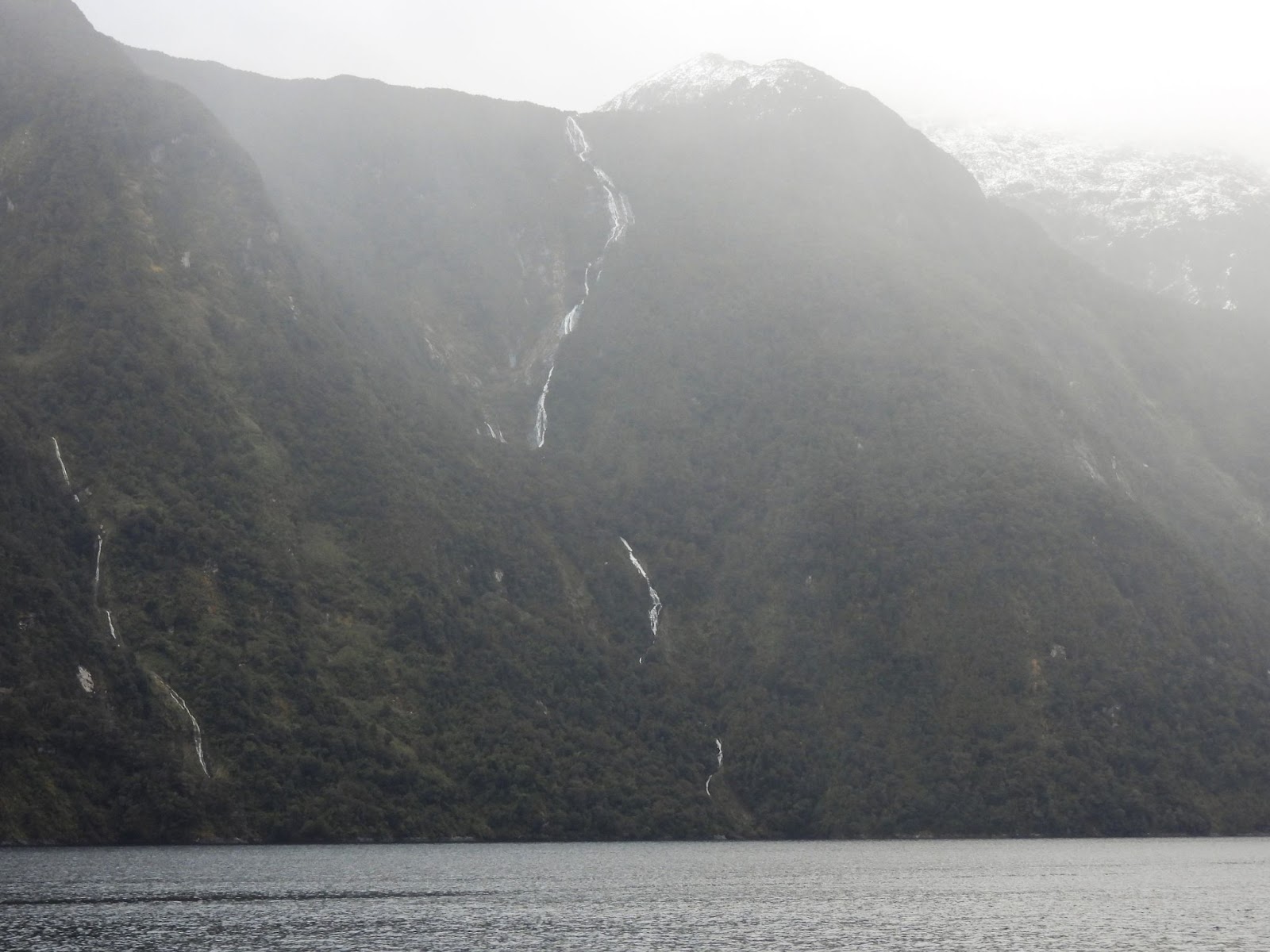
Another story. I took the picture one morning on a cruise we took through Doubtful Sound, on the South Island of New Zealand. 


#29  The Land of Vertical Rivers


Come children; listen to my story about a faraway land of mountains, clouds, and sea. 


The mountains there stand straight and tall, and clouds cover their tops like a wooly blanket. The sea rocks itself all around. 


The clouds give of themselves to the mountains. They nourish small, wild, happy rivers, which rumble-tumble down the steeps to the sea, sometimes flinging themselves into the air in their joy. They carry with them offerings from the mountains, which nourish the sea. 


The sea accepts their gifts, and in its pleasure, sends the purest part of itself up to nourish the clouds. 


Today's final project. 

A friend gifted us recently with a bag of hot peppers.


I started by chopping them and letting them soak in salt for three days. Then came vinegar and
other spices.

Some of the peppers were also added to olive oil. It's got some kick now. I tried some of it just today

as I made a fried-bologna and fried-egg sandwich for lunch.

The other bottle you see has nothing to do with the peppers, but I was multi-tasking as I took the picture.

It is a version of Limoncello, using vodka as the base, but made with mandarins grown in our village

instead of lemons. Top notch. I think it's better than the Limoncello we made about a year ago.


Projects don't have to be huge undertakings to be good ones. I am enjoying the projects I now pursue.

See you next week. -djf


Saturday, 13 July 2024

Just a little trim, please.


This first picture was taken from our balcony a few weeks ago.


Here is another shot of the same palms, but from the ground on the other side of the roundabout. 

I think you'll agree that the palms are beautiful. I like the seed pods hanging down especially.  Before we moved here, I never knew that some palms grew them like that.  

However, the area below those palms is well traveled. Fronds, spathes, or seeds can and do fall sometimes, and if one of our elderly residents is struck, it could lead to serious consequences.

Therefore, the tree barbers come in regularly, and give our palms much-needed trims.  Let's take a quick look at the latest cut. 

That's quite a reach for that bucket truck. 


Trimming the palm closest to our balcony. 


After the trim, the foliage looks much neater.  


This is the new view from our balcony.  


If you go back up to the first picture, and look at the far left, between the buildings, you'll see how the fronds were obscuring the view of the north-east horizon.  

Now, with the cleanup, the sunrise is once again visible. I took the following shots this morning, 7/12/24.  


By the way, the Sun is once again moving southward each day from its northern-most point. In this photo, I have marked its solstice position and direction of rising with a line. It would of course, move in the opposite direction in the Northern Hemisphere. 


To close out this post, here are a few of the zoomed in shots from this morning.  I can't resist super close-ups.  -djf


Saturday, 6 July 2024

The winter African Garden and Fernery

I'm writing this on July 4, 2024.  My header photo today shows frost on the roof, something that doesn't happen very often.  The average number of frosts per winter, since I've been in NZ and sort of keeping track, is three to four, but I don't remember even one last year.  

Despite the frost, the day turned out to be beautiful. The temperature got up into the 60's.  It would have been a good day to go to a parade, or to ride on a float in such a parade, like Mary did. Instead, I wandered around and decided that a few shots of what the African Garden and Fernery look like would make a suitable post.    

I'm leaving the north end of the Atrium here. You can see the barrier put up around the scaffolding for the Palms remediation project. 


Since I'm walking right past it, I though I'd show Dianne and Kathie their room location. It's the one with the closed drapes, on what we call here the first floor.  (above the ground floor) 


It may be winter here, but plants keep to their own schedules.  


Our fernery. 


Our 'flock' has moved since the rebuilding has started.  


I have moved from the African Garden area to our central roundabout for a look at these birds of paradise flowers.  


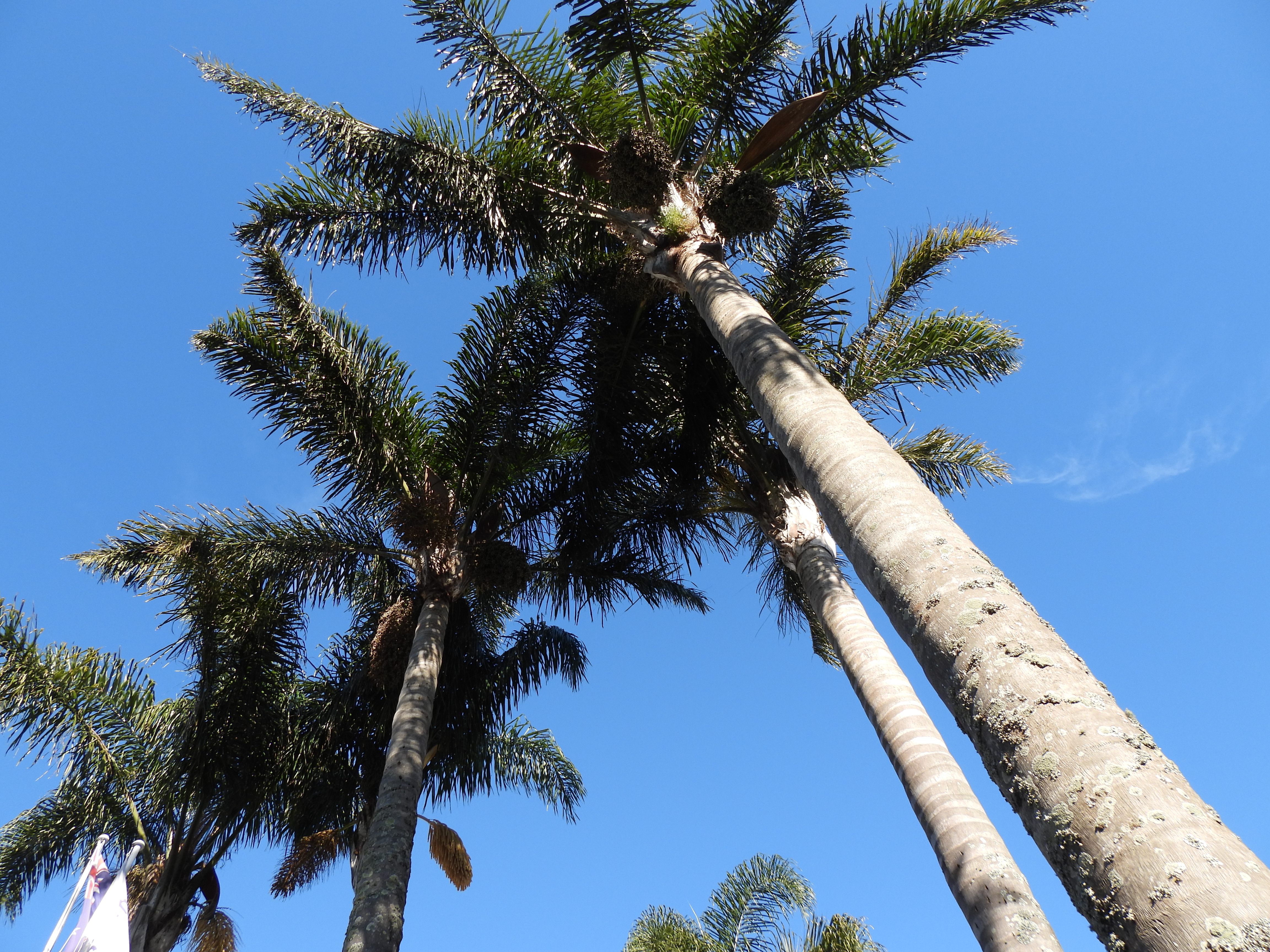
Finally, to close this post off, a last look straight up.  I'll never get tired of palm trees.   -djf


Saturday, 29 June 2024

Waitakere Garden Sharecroppers

It's Friday, June 28 today. That's Matariki Day, if you live in New Zealand.  This day, which celebrates the Maori New Year, has been celebrated for ages, but only since last year has it been officially listed as a national holiday.

I've done posts about it in the past so I'm not going to repeat myself and show you pictures of the day. Instead, I want to show you the status of our sharecropper's gardens.

During the winter here, which runs from June through August, our gardens naturally produce much less.  You'll see in some of my pictures, how low the sun appears to be at almost 10:30 in the morning. Lower temperatures also contribute of course to slowing down production.  

Well, as usual, Jeanne is always thinking.  This time it was how to increase our supply of vegetables to supply the Monday and Thursday veggie-stand in our Atrium. If the supply decreases because of limited light and cooler temperatures, the only way to increase production would by planting more area. Even if it all grows more slowly, more will be growing and eventually be ready to harvest.  

If you've been reading my posts then you know that our retirement village, besides having community gardens, where the veggies and flowers are grown by volunteers for our above mentioned weekly 'market,' also makes small individual sized plots available to those who sign up for them. During the summer, those folks plant their own mini-gardens and harvest whatever they decided to grow.  Most however, let their plots lie dormant during the winter.  

It was to those folks whom Jeanne made this proposition:

"If you're not using your garden plot anyway because of the winter, why not let me use it during that time. I'll plant something in it and when the crop in your plot is ready, I will harvest it and contribute it to the community veggie-stand, but I will share a portion of it with you as well.  You will get a  small crop of winter veggies without lifting a finger and the community will benefit because of your generosity. In addition, I will return your plot to you in the spring in better shape than it is now.  I will dig in compost and have your seed bed ready to go."

As you'll see from my pictures below, a number of people decided to take her up on her offer.  In fact, she had to turn a few people down when they offered their plots, because she quickly got all the offers she could manage. 

This first one is Jeanne's own garden plot.  She contributed carrots to this past Thursday's 'market.' 


Pukekoes are a real threat and so many gardens need to be covered, especially while the plants are small.  In many of the following pictures, Jeanne has removed part of the protective barriers so I could get a better photo.  


This shot illustrates how low the sun is. 


Several of the sharecroppers have asked Jeanne recently how their plot is doing. One asked,  "Are my carrots ready yet? 

As you can see, the carrots have quite a ways to go yet, but then, winter is just beginning. They're off to a very healthy start though and they'll grow to harvest size eventually. I think this plan is a brilliant way to benefit everyone concerned. 

I have to bring up to to date as well on Jeanne's asparagus bed. After two years of work planning, building, filling, planting, and fertilizing, it will soon be producing. I think the folks who come down to the Monday and Thursday veggie-stand will be pleased to see bundles of asparagus spears being offered.  


There are only a few at present, but just you wait.  


One last picture. The tree-pruning company is coming next week to trim our palms.  They need it, as you can readily see.


That's it for this week. Let's give Jeanne a round of applause, wherever you are.  -djf


Saturday, 22 June 2024

An old one

Here is something I wrote quite some time ago. I'm guessing about 2011. I'm pulling it out of mothballs now because I don't have any other post for this week. This will have to do.  

I had heard the saying, "Better to remain silent and be thought a fool, than to speak and remove all doubt." 

Writing probably demonstrates one's mental status even more clearly than speech does, and many of you may find this, whatever it is, rather foolish.  Can't be helped.  Reading this again, and editing it slightly, dredged up a lot of good memories for me. I hadn't thought of Richard in a long time and I wonder how he's doing.  

Enough introduction and excuses and procrastination.  


Them Thar Hills

D. Foster


Several weeks ago my friend Richard, “The Professor,” called and announced that he is working on yet another book. It's one of those “List of Things I Like” books that were popular at one time.  He asked me if I cared to suggest a few of my own ‘likes’.  If they were plentiful and good enough, he said, I’d get credit in the introduction.


Always ready to help, and figuring that this was the best chance I had of ever getting anything of mine published, I rattled off several things that had always been at the top of my list of ‘likes’.   He quickly pointed out that he hoped to be selling his book in those ‘bookseller’ places that are in every airport across the country, and not to be doing free ads for scotch and cigar companies.  Well, that eliminated a portion of my list, and some of the very best in my opinion.   ‘Plentiful’ was going to be harder than I thought. And what he would consider ‘good enough’ was anybody’s guess.


Besides, if he was planning to sell this book in airports, he’d be a lot more likely to sell them if it contained a “List of Things  I Don't Like”.  It’s been my experience that people in airports these days are not going to be looking for ‘touchy, feely’ sweetness.  What they want is something that will match their level of frustration, something that will put some 'starch in their shorts.'  


In my version of this book of his, the chapter on “Things I don’t Like About Airports” would be first in the table of contents and would probably be the longest list in the book.  I think that sort of book would leap off the shelves, straighten the spines of those flyers in the lines awaiting their session with the T.S.A. agents, and may ultimately even help to defeat any terrorist element that might be loitering in one of the airport food courts.  All this political correctness is nothing more than political ineptness in my opinion.  But what do I know?


His suggestion though, did get me thinking of the other sorts of things that I like, once I eliminated all those top-shelf items and concentrated on the things of a more mundane nature.  Here then, are a few things I like. 


Treasure.   Many years ago, I had the foresight to meet and marry a woman whose father owned land.  Lots of land.  Farmland in what is known locally as the ‘banana belt of Upper Michigan,’ for its relatively benign climate.  This productive land continually yields up all sorts of treasures.  All you have to do is to go out there and find it lying around somewhere, and bring it home to enjoy.  It’s true that the land can also yield bounties of crops, firewood, and stone fences, but those things take a lot of effort to produce and if you ask me, are not the true treasures of the land.  


Now, I’d like to adapt an old saying and admit that ‘one man’s treasure is another man’s trash,’ so if you don’t agree with my list of treasures, go figure out a list of your own.  I think that realizing what your particular ‘treasures’ are is good for your soul.


A great early American pioneer, Yosemite Sam, once shouted, “There’s gold in them, thar hills.”  Well, he was wrong, as far as I know, about there being gold in any of my hills. I inherited some and subsequently purchased another big one and a couple of smaller ones, but there are other riches in them that Sam probably didn’t consider when he made that claim. 


Float Copper:  Float copper is chunks of copper ore, nearly pure, that were torn loose from copper deposits by glaciers in the last ice age and left lying around, north and west of here, in what’s known, not surprisingly, as the ‘copper country’ of Michigan's Upper Peninsula, when they melted.  This stuff was recognized as a valuable commodity by the very earliest people that moved into the area after the ice exited, and they hauled pieces of the stuff far and wide, trading it with other peoples. Archeologists have found pieces of Michigan copper as far away as Mexico.


During one of these trading journeys, some early resident must have forgotten to pick up his load of float copper one morning, after camping for the night at a spot that would one day, ages later, become one of my father-in-law's farm fields.  Dave, my aforementioned f-i-l, while picking stones one day in his newly plowed field prior to planting, found three big pieces that probably weighed 60 pounds in all. A seventeen pounder is now holding open my basement door. 

Mushrooms:  Another treasure is any member of a family of mushrooms, known (to me) as the Morchella sisters; Morchella esculanta, M. deliciosa, and M. elata. (scientific binomials) 


(“The tune from the West Side Story song, ‘Maria’, should now start playing softly in the background of your mind.)


…“ Mor-chel-la.  I just found a ‘shroom called Mor-chel-la.”  “And suddenly that name, will never be the same….to me…” 


“Say it loud, and there’s music playing…”


“Say it soft, and it’s almost like praying…”


“Mor-chel-la……


Okay, maybe it is a little over the top to describe the polymorphic fruiting body of a fungus in such terms, but if you can’t forgive me for getting carried away, it’s undoubtedly because you have never put such a fruiting body in your mouth.  Whether you fry them in butter, cook them with scrambled eggs, or, and I do say this softly and reverently, batter and deep-fry them, they are the queens of all mushrooms. 


And, when I tell you that it has been reported to me, by reputable sources, (Fred and McKenzie) that they just saw four fresh, average sized Morchellas (a.k.a. morels) selling for $20.00 in a fancy organic market in St. Paul, Mn., you will possibly understand how rich I feel, having gathered approximately 600 of the beauties last spring. 


Such a treasure can be worth a great deal of money, as I’ve just demonstrated, and it bothers me that I should probably be investing in some sort of vault for my stash, and not just keep them in my chest freezer, as I’m doing now.  What if my home were burglarized? 


The cop investigating the theft would probably say something like, “Well, this guy’s house isn’t worth beans, and he had no possessions, jewelry, or cash to speak of, but the perp cleaned out his freezer to the tune of about 3 Grand!”


Now,  some other mushroom lovers I know, Fred and Mike specifically, have admitted to being enamored of other ‘ladies’ beside my lovely Morchella sisters.  They have the hots for a rather hefty beauty they affectionately call their little ‘hen of the woods’.  Her real name is Grifola fondrosa.  Hmmm….Grifola. Sounds like she might look like one of those flashlight-toting lady ushers at a Russian cinema.  This ‘little hen’ can go 10 pounds without even trying, so if you like lots of ‘lady’, this might be the mushroom for you too.  Me, I like ‘em petite and shapely, so I am staying faithful to my ‘girls’. 


But it’s not always easy to stay faithful to them.  They, like some human ladies, have their ways of keeping us in our place.  Hunting them is easy, they hang in all sorts of places, but actually bringing them home ‘to meet the folks’ so to speak, can be very tricky indeed.


You wouldn’t think it would be very hard, since they can’t run off when you approach, but they, like all females of every Genus and species, have their wiles.  They take an attitude.  Many a time I have spotted a real keeper, 10 or 20 yards off, that starts my heart doing flips, and I rush over to meet her and entice her to come with me.  By the time I reach her though, I find that she has turned into an upturned leaf, the end of a stick, a hunk of corncob, a pinecone, or some other such thing.  I have often waited patiently for her to turn back into herself or have even re-traced my steps to the point where I first spotted her, but I have found that once she has changed, she stays changed, at least I suspect, until I’m out of her neighborhood.  I’ll bet that I no sooner than I turn the corner than she makes the change, and is as cute as ever, waiting to frustrate the next poor sap that is out for a stroll among the leaves.  


Fighting/throwing/walking sticks:  About 1961 or so, my brother Wayne and I watched the 1938 classic, Robinhood, starring Errol Flynn.  Especially impressive to our 6 and 10 year-old eyes was the fight scene over the river that Robin and Little John waged with ‘fighting sticks’, as we dubbed them.  As we watched, we knew that our lives would not be complete until we had each provided ourselves with such an indispensable tool of manhood. 


I, by that time, was the proud owner of not only a cub-scout pocketknife, but a recently acquired small hatchet.  This was wielded most of one morning to hack at approximately two dozen saplings, most of them ironwoods I found out much later, until we finally happened across a couple of spindly aspens that actually fell.  A short time later, Wayne and I began to practice our skills, remembering and trying to duplicate the moves we had seen the night before. What we discovered was that we, unlike Robin and Little John, spent most of our time rubbing badly bruised knuckles.  How our two heroes could so successfully handle their weapons while we only made each other mad was a real source of frustration to both of us. 


Still, it didn’t take us long to decide that Robin and Little John, probably off camera, also used their ‘fighting sticks’ as spears.  We hadn’t noticed during the movie, if one end of each stick was honed to a razor-edged point or not, but thought that they probably were, and if they weren’t, they should have been. 


We lost no time therefore, in beginning to work one end of our sticks to that deadly point needed on any good projectile.  I told Wayne that I had heard somewhere that cavemen had sharpened sticks and then tempered them in a fire to keep the tip from blunting.  Wayne was as enthusiastic as I was about immediately getting a good fire going and doing the same with our spears, but since the fire making materials at our house were carefully monitored by our mother and in one of the upper cupboards besides, we didn’t really think we’d be able to start one, just to do some tempering.  We decided to talk our dad into building us a wiener-roasting fire and then to nonchalantly stroll in with our spears for a quick tempering between the wieners and the marshmallows courses.   Wayne actually came up during our next ‘roast’, with the idea of impaling half a dozen marshmallows in a row on the end of his spear, thus ‘toasting’ his marshmallows and tempering the tip in one step, but that was cut short by dad when Wayne began waving his five foot long, now flaming spear over the heads of my three screaming sisters.  Wayne’s spear was confiscated by dad, the fire extinguished and the threat handed out that if he ever caught us throwing sharp sticks around the yard, he’d ‘whale the tar’ out of both of us.  Since dad’s threats were invariably carried out in exactly the manner and to the degree described, we recognized that our current adventure in Sherwood Forest was over, at least while we were in our yard. Dad never ventured into the woods.   


Besides, Robin and Little John were also crack shots with bows and arrows.  Dad hadn’t said that he had anything at all against a well-made English long-bow (where’s my hatchet?) and we found that goldenrod stems made passable arrows, though they did tend to curve a little in flight. 


Now, almost 50 years later, I find myself still enamored of a good stick, either straight or with artistic, natural bends and knobs.  I harvest them from ‘the land’, my very own grown-up Sherwood Forest, and haul them home.  I strip the bark and dry them, then sand them till they shine, and layer on various coatings designed to bring out their natural beauty.  I use them occasionally when I take hikes around my 130 acres, and figure that at my current rate of wear on the business end, I should have enough walking sticks to last about 10,000 years, give or take.  If you need one yourself, let me know.  I can probably spare it. 


At this point, I must apologize for cutting short my list of treasures.  My fields and woods regularly give up other wonders that I will have to discuss at some future time.  Fossils are widespread.  So are those little white ceramic insulators that were used to support electric fence wires in the old days.  Colorful wild turkey feathers, white-tail deer antler sheds, and even parts of animal skeletons come home regularly with me and are used, respectively, to adorn Jeanne’s artwork, to give to a friend who hand-makes pens, or to share with Charlie, the neighborhood mastiff, who appreciates bones of any description.     


Right now, though, the evening is upon me and it’s time to refresh myself, body and soul, with a couple of my ‘top-shelf likes’ mentioned earlier, that my friend Richard, is apparently unaware of.  A wee dram or two (Okay, maybe not so wee) of smoky, Scottish Laphroaig and a Cuban puro (You can find them if you look) will set just the right mood for the glorious sunset that is just beginning to blaze off there, across my hills…. 

Great Horny Toads!  I just realized that Yosemite Sam was right after all, there IS gold in them thar hills.


Well, that's it for this week.  To any of you who might be harboring an inclination to write of your own adventures, I say go for it.  You'll be glad that you did.     -djf


Saturday, 15 June 2024

A return to the yellow wood.

"Two roads diverged in a yellow wood."  That's the first line of Robert Frost's The Road Not Taken. Here it is, just to refresh your memories.  

Two roads diverged in a yellow wood,
And sorry I could not travel both
And be one traveler, long I stood
And looked down one as far as I could
To where it bent in the undergrowth;

Then took the other, as just as fair,
And having perhaps the better claim,
Because it was grassy and wanted wear;
Though as for that the passing there
Had worn them really about the same,

And both that morning equally lay
In leaves no step had trodden black.
Oh, I kept the first for another day!
Yet knowing how way leads on to way,
I doubted if I should ever come back.

I shall be telling this with a sigh
Somewhere ages and ages hence:
Two roads diverged in a wood, and I—
I took the one less traveled by,
And that has made all the difference.

I referred to this poem quite some time ago in a post when I talked about how satisfied I was
that Jeanne and I had taken the path through life that we did.  

I think that most people who read that poem think of it in those terms. That the road taken was
the better of the two for the traveler. However, it could also mean that along the road not taken
there were opportunities that were lost because the traveler went the other way. Just the
opposite of what is usually supposed. Is there possibly a little regret in the tone of the poem? I
don't know. I think that poem is open to lots of conjecture. 

Well, I've continued thinking about this 'bit of forest' that I now inhabit and my recent
wanderings through it.    

I'm no longer in the same yellow wood that we explored originally, of course. I think there
have been innumerable yellow woods that Jeanne and I have traversed during the last 50
years together. (I think that 50 years qualifies 'now', as ages and ages hence.)  In each, we've
made a decision, and the new roads we've chosen led us into yet further woods; with each of
them containing even more diverging choices for us. I think that retirement might be a time
when we can return to some of the paths not taken in the past and explore what we were
unable to explore originally. It also allows us, based on hindsight, to decide against continuing
along certain roads.  

Case in point. I have made a conscious decision to avoid any path that leads me to politics. I am hugely disappointed and disgusted in what has been done to our country, by politicians in their quest for power, and the media for their unconscionable bias. It infuriates me. I know that I can do nothing about it and therefore I now limit my exposure to it. Rightly or wrongly, I have decided to withdraw from participation in it as much as is realistic.  

I have found it hard to avoid talking politics here in NZ.  It seems that most Kiwis I meet ask me what I thought of Obama, or think of Trump or Biden.  Logical questions certainly. And good ice breakers. Kiwis follow American politics closely. 

When we arrived at the Gardens, I let it be known to those first folks who asked me such questions, that I hated talking politics and credit be to them, those questions stopped immediately. I did however tell  them succinctly, exactly what I thought of each of those people mentioned. I think some of them said, 'Whoa,' and mentally stepped back a pace or two from me.

I saw a very interesting cartoon in the newspaper here about two of NZ's many political parties. The cartoon said that the voter's choices were not good. One party showed incredible stupidity while the other party was pure evil.  Wow, I thought, they could be talking about the U.S. I leave it to you to decide which of our parties is which. I'm sure discussion could be generated about that too, but that's another discussion I want nothing to do with. I know what I know.   

So, where am I going with this topic, and this mild diatribe of mine?  (Wait, can a diatribe be mild?)

I guess that I am once again thinking about retirement and my place within this time of life. 

I took the following picture, which I call, Cactus, with Primates, up on the third floor of the Atrium, here at Waitakere Gardens. 


I think I was once very like them. Climbing my way up the career tree and sometimes finding the going somewhat prickly. 

With retirement, I have now jumped clear of that part of my life. I can scamper (Or more accurately, shuffle) around freely now and look back with pleasure that I successfully completed my stint in the workaday world.   

I mentioned earlier that in retirement, I might be able to explore some paths that I didn't take originally.  I'm doing that.  

I found two series of physics lectures on YouTube, given by an MIT professor named Walter Lewin. I am enjoying them immensely.  In total, there are about 70 lectures, numbered 801 and 802, each lasting about 50 minutes. They are perfect for me.  The topic is interesting, but I can skip ahead when he gets too deeply into equations. (The math is well beyond my current abilities.) I don't have to take any of his exams either.  What a good thing that is. 

(I never thought I'd be auditing courses at MIT.)  

I started watching him when I happened across one of his lectures on magnetism, something I've been interested in since I was a kid.  I used this picture in a previous post I know, but I include it here again because it's one of my favorites.  

Generally, we think of magnets as attracting one another, but I enjoy looking at the results of their like-poles repelling each other another even more.  


I should mention to those seeing this for the first time that what I'm showing you is a 3 mm brass, non-magnetic rod and N45, cylindrical neodymium magnets, each with a 4 mm hole through them vertically, which can slide freely along the rod, supported by the magnetic fields extending out from their like-facing poles.  There are three more of those cylinders joined together inside the stainless steel container. They provide the field that repels the three that you see hovering above.    

I guess that that is enough philosophizing for today.  Take it for what it's worth.  

I'll be back next week with another post of some sort. I haven't yet decided what it will contain, although I do promise that it'll have no further rants about politics.      -djf